Kenyans built much of their country from below: its schools, its savings institutions, its political space and its constitution. Their protests, petitions and lawsuits have stopped tax bills, foreign concessions and a constitutional amendment, yet their victories leak where the state must answer and act. This article follows the organised citizen through five roles, finds where the accountability chain breaks and who gains when it does, asks whether civil society should take power or audit those who hold it, and what the builders of Kenya should build next.
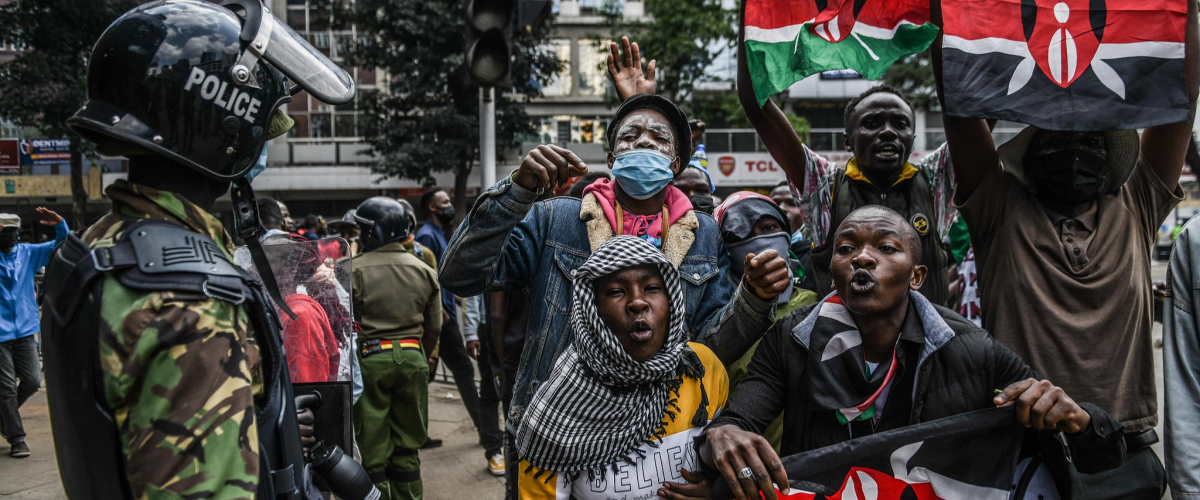
On 25 June 2026, the second anniversary of the day young Kenyans broke into Parliament during the revolt against the Finance Bill, activists, lawyers, opposition leaders and the families of those killed found razor wire across Parliament Road, laid their wreaths on it and sat down. The state answered with roadblocks, 355 to 361 arrests and seven enforced disappearances. Nobody was killed, which in Kenya now passes for a calm anniversary: the same date in 2025 had cost between 16 and 23 lives, and Saba Saba day, two weeks later, between 38 and 41.1
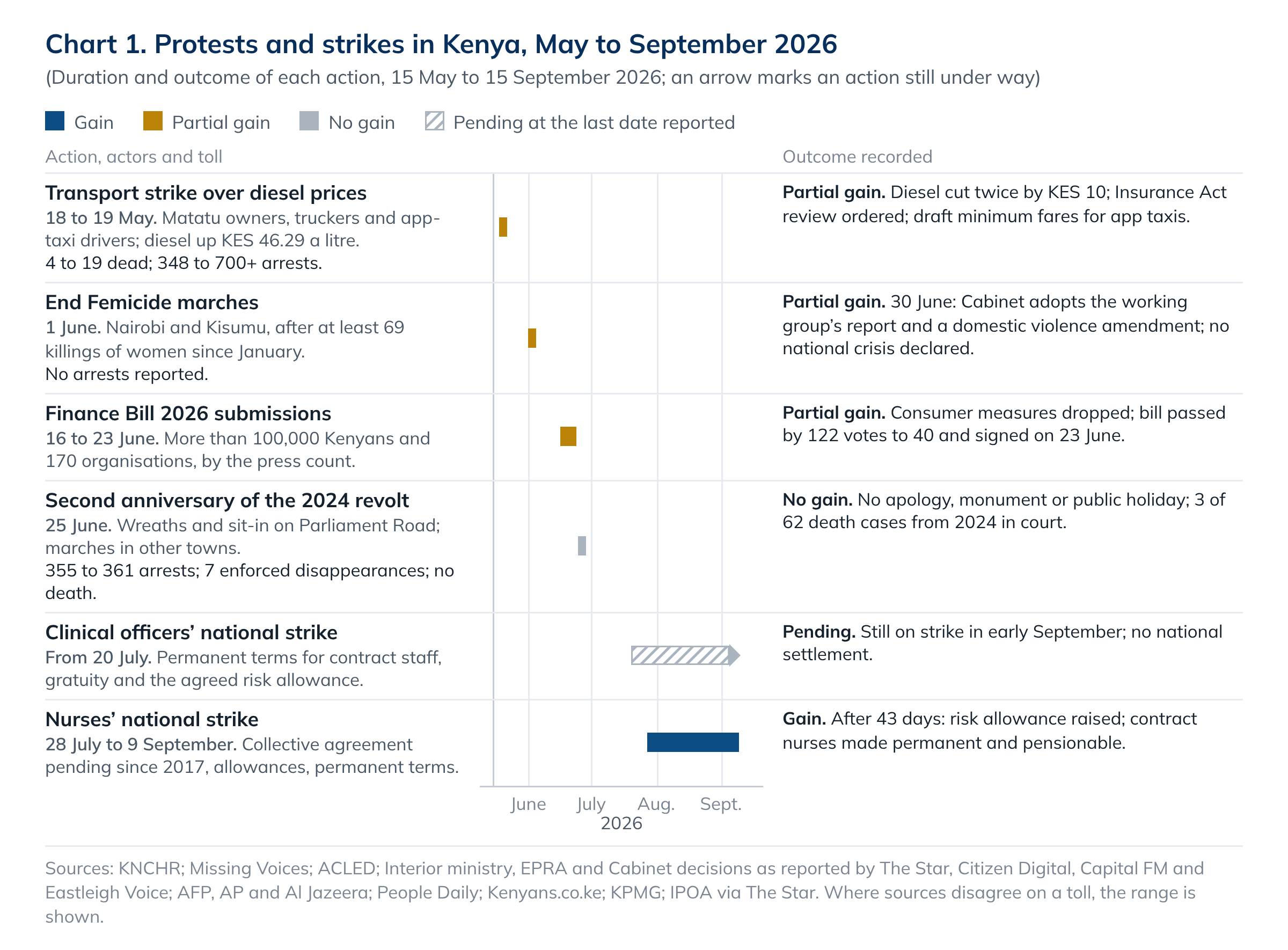
I witnessed five protests in barely two months, between May and July 2026: over the Finance Bill, by drivers, against violence against women, over insurance and health care, and others besides. They were not one movement, and each won something, or nothing, on its own terms (Chart 1): the drivers who stopped the country on 18 and 19 May, after diesel rose by 46 shillings a litre, obtained two cuts of 10 shillings and a review of the Insurance Act, at a cost of between four and 19 lives; the marchers on Parliament Road obtained no apology and no monument.
Kenya takes to the street more than its neighbours: 7.4 percent of adults had joined a demonstration in the year before Afrobarometer’s 2024 survey, against 3.5 percent in Uganda and 0.8 percent in Tanzania, and a tracker run by Odipo Dev and Amnesty International Kenya counted 453 protests in the first half of 2026, 29 percent more than a year earlier, most often over economic freedom.2 The economy they protest about grew by 4.6 percent in 2025 and leaves four Kenyans in ten below the poverty line, and it stops at a door: a state that hands two thirds of its revenue to creditors cannot buy inclusion, and citizens who doubt where the money goes will not volunteer more.3 This article goes through that door. Its short answer is that Kenyan civil society holds a veto and rarely the pen: it can stop a measure, it struggles to shape what replaces it, and it almost never obtains a sanction.
Where the organised citizen enters the arithmetic
Civil society here means savings and credit co-operatives (SACCOs) and savings groups (chamas), public benefit organisations, congregations, unions and residents’ associations. Two relations locate its place in growth: a speed limit, g ≈ s ÷ v, by which a country grows at about its investment rate (17.9 percent of GDP in 2025) divided by the capital it needs for each extra unit of output (about 3.6), and the growth elasticity of poverty, η. Civil society moves all three terms. It raises s when people save together and trust the state enough to pay it: SACCO members held 833 billion shillings in deposits at the end of 2025, and 46.5 percent of Kenyans told Afrobarometer in May 2024 that most or all tax officials were corrupt. It lowers v when public money buys what Parliament voted: the IMF found 300 to 500 national projects stalled in 2023, worth 8 percent of GDP. Public development spending came to about 4.9 percent of GDP in FY2025/26; if stronger institutions closed two thirds of the average 30 percent efficiency gap that the IMF measures in public investment, Kenya would recover about 1 percent of GDP a year (two thirds × 30 percent × 4.9 percent), which, divided by 3.6, is a quarter of a point of growth, every year. It widens η when budgets follow the needs of the many.4
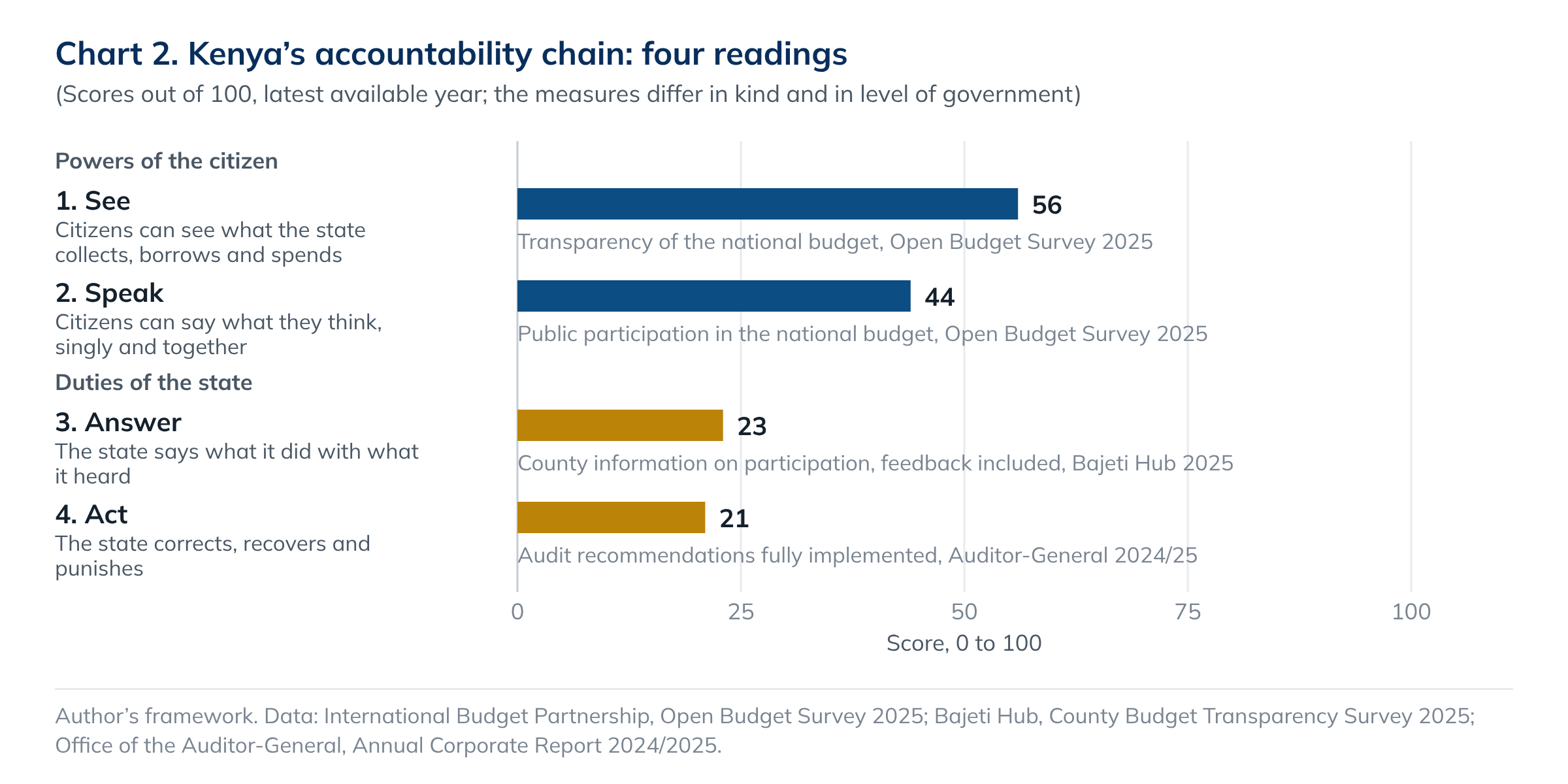
All three channels need the same condition: someone has to answer. This article calls that condition the accountability chain, with four links: citizens must be able to see what the state collects, borrows and spends, and to speak about it; the state must answer, saying what it did with what it heard, and act when something is wrong. The first two are powers of the citizen, the last two duties of the state, and a chain holds only as well as its weakest link. Kenya’s readings (Chart 2) slope downward, strongest where the citizen acts and weakest where the state must; Jonathan Fox’s review of the evidence on social accountability says why: information alone is weak, and voice needs teeth.5
The builder: a country assembled from below
Organised society in Kenya is older than the independent state. Jomo Kenyatta made harambee, pulling together, the watchword of the new state, and for two decades Kenyans built by subscription what the Treasury could not fund: some 37,300 projects between 1964 and 1984, 12 percent of gross capital formation, nine shillings in ten of it given by private individuals; by 1989 six secondary schools in ten were harambee schools. The institution had two faces: leverage for peasants who built for themselves and could bargain with the state, in Frank Holmquist and Joel Barkan’s reading, and, in Ken Opalo’s, loyalty bought one fundraiser at a time, until Parliament made the practice a budget line in 2003, the Constituencies Development Fund.
The second thing organised Kenyans built was political space: churches, lawyers, an independent press and crowds undid the one-party state between the banned Saba Saba rally of 7 July 1990 and the repeal of the one-party clause in December 1991. The third was the constitution: bishops, rights groups and the religious leaders who opened their own drafting process at Ufungamano House in 1999 set the review in motion, 125 civic delegates sat at the Bomas conference, twice the political class took the process back, and on 4 August 2010 Kenyans adopted the text with 68.55 percent of valid votes. It reads like a charter for civil society: sovereign power belongs to the people, participation, transparency and accountability bind every organ of the state, citizens may demand information, assemble, petition and sue in the public interest. In the terms of this article, 2010 wrote the first two links of the chain into law and promised the other two.6
The builder left two inheritances: a habit, where the state is absent, organise and provide; and a text, where the state is present, it must listen and answer. In Peter Ekeh’s terms, Kenyans have spent sixty years strengthening the primordial public of kin and community, to which they give freely, and sixteen trying to give the civic public inherited from the colonial state a conscience.
The provider: the economy Kenyans built for themselves
The habit of self-provision has become an economy, and it carries much of what inclusion Kenya has. At the end of 2025 the 357 regulated SACCOs held 1.21 trillion shillings in assets for 7.87 million members, a movement the World Council of Credit Unions ranks 13th in the world by assets, the only African one in the top fifteen. Three adults in ten use a chama, a share that has held near 30 percent since 2006 while formal financial inclusion rose from 26.7 percent to 84.8 percent. For the small and medium firms that banks seldom reach, this is the part of the financial system that its users own: a SACCO lends its members’ pooled savings back to them, 597 billion shillings of credit in 2025, of which 157 billion went to housing, 126 billion to education and 109 billion to agriculture. For a boda boda rider with no payslip, one of the 862 boda boda and tuk-tuk SACCOs that 26 counties report having registered can be the first formal body he joins: formalisation can begin in a members’ association. The same economy shows what a missing chain costs inside civil society: a forensic audit found 13.3 billion shillings lost at KUSCCO, the SACCOs’ umbrella union, and only 22.4 percent of registered NGOs filed a return in 2022/23. An organisation that asks the state to open its books argues from weakness when its own are closed.7
The voice: from the street to the hearing room
In political decisions, Kenyan civil society’s record is first a record of stopping things. Of 45 contests with the state since 2013 coded for this article, it won 19 outright and 12 in part, 14 of them through the courts, 7 through submissions and advocacy, 4 through the street and 4 through several channels. The courts deliver the most victories, the street the largest (Table 1).
The street’s victory removed a whole tax package: Members had passed the Finance Bill of 2024, meant to raise 302 billion shillings, by 195 votes to 106, and the protesters, who had representation, wanted an account. The bill was withdrawn, and its shadow changed what came after: in June 2026, after more than 100,000 Kenyans and 170 organisations had sent submissions, Parliament deleted the consumer measures that had drawn most fire.8
The courts’ victories are narrower, and more of them hold: the Building Bridges Initiative halted in 2021, the Adani concessions frozen by the High Court and cancelled in 2024, provisions of the public-private partnership law struck down in 2026 for letting the executive take on public liabilities without Parliament. Victories also leak, as the last column of Table 1 records, and some orders wait years for execution: the law on public benefit organisations, passed in 2013, came into force only in 2024, after court orders of 2016 and 2017 that the government ignored for seven years, and on 25 June 2026 police disregarded rulings that officers at protests must be identifiable. The method is costly: the human rights commission investigated 60 killings and 71 abductions between June and October 2024 alone. A veto exercised from the street is paid for in lives, and it settles one decision at a time.9
Table 1. Seven fights, 2021 to 2026
| Measure | Years | Main route | Result | Did it last? |
|---|---|---|---|---|
| Building Bridges Initiative constitutional amendment | 2021 to 2022 | Courts | Struck down at three levels | Yes |
| Housing levy | 2023 to 2024 | Courts | Struck down, 28 November 2023 | Back in a new bill six days later; in force March 2024 |
| Finance Bill 2024 | 2024 | Street | Withdrawn | Yes, as a bill |
| Cabinet and police chief | 2024 | Street | Cabinet dismissed; Inspector General resigned | Ten dismissed ministers renominated |
| Adani airport and power-line deals | 2024 | Whistleblower, courts, union strike | Cancelled | Yes |
| Finance Bill 2026 | 2026 | Submissions | Consumer measures dropped | Enacted, June 2026 |
| Prosecution of police for 2024 protest deaths | 2024 to 2026 | Complaints, litigation | 3 of 62 cases in court | No conviction reported |
Sources: Kenya Law judgments; National Assembly; State House; press reports cited in the notes. Author’s selection from the 45 coded cases.
Pressed by the courts and its own commissions, the state has begun to give organised citizens a place in the machinery, most of all through the Public Participation Bill passed by the National Assembly on 12 August 2026, the first law on the subject in sixteen years, which would oblige public bodies to give notice, weigh what they receive and report afterwards. What Parliament owes those who write to it remains unsettled, the Supreme Court having reversed a Court of Appeal ruling that faulted the National Assembly for giving no reasons for rejecting public proposals. Kenyans are not yet persuaded: 58 percent told Twaweza in 2025 that public input to county decisions only informs citizens of what has already been decided.10
The watchdog: Kenya sees, speaks and seldom sanctions
Much of what Kenyans can see is civil society’s own work: the Open Budget Survey puts the transparency of the national budget at 56 out of 100, short of the 61 it treats as sufficient, and Bajeti Hub, a Kenyan budget organisation, has scored every county budget since 2020, the average rising from 33 to 65, not least because counties publish more once they have seen their draft scores. Sight matters most on debt, where the Open Budget Survey singles out Kenya’s sector hearings as the clearest open platform in sub-Saharan Africa, and where Okoa Uchumi, a campaign of more than 90 organisations, asks that every loan, guarantee and public-private partnership contract be published within 30 days. Sight also has limits: fewer than one in four of the 2,746 audit opinions issued in 2024/25 were clean, and railway contracts ordered disclosed in 2022 were still partly withheld twenty months later.11
Then the chain stops. Of 580 recommendations that Parliament’s Public Accounts Committee made on the 2020/21 accounts, the Auditor-General found 79 percent not fully implemented; of 63 performance audits sent to Parliament since 2012, members had debated two; of people who met bribery in a public service, 97.2 percent told no authority; of the 62 deaths of the 2024 protests registered by the police oversight authority, three cases had reached court by June 2026, without a conviction. The prosecution over the Arror and Kimwarer dams, valued at 63 billion shillings, ended in acquittal after the prosecution called 8 of its 49 witnesses, while the loans for those dams and a third remain on the public books: 226.7 million euros outstanding in June 2024.12
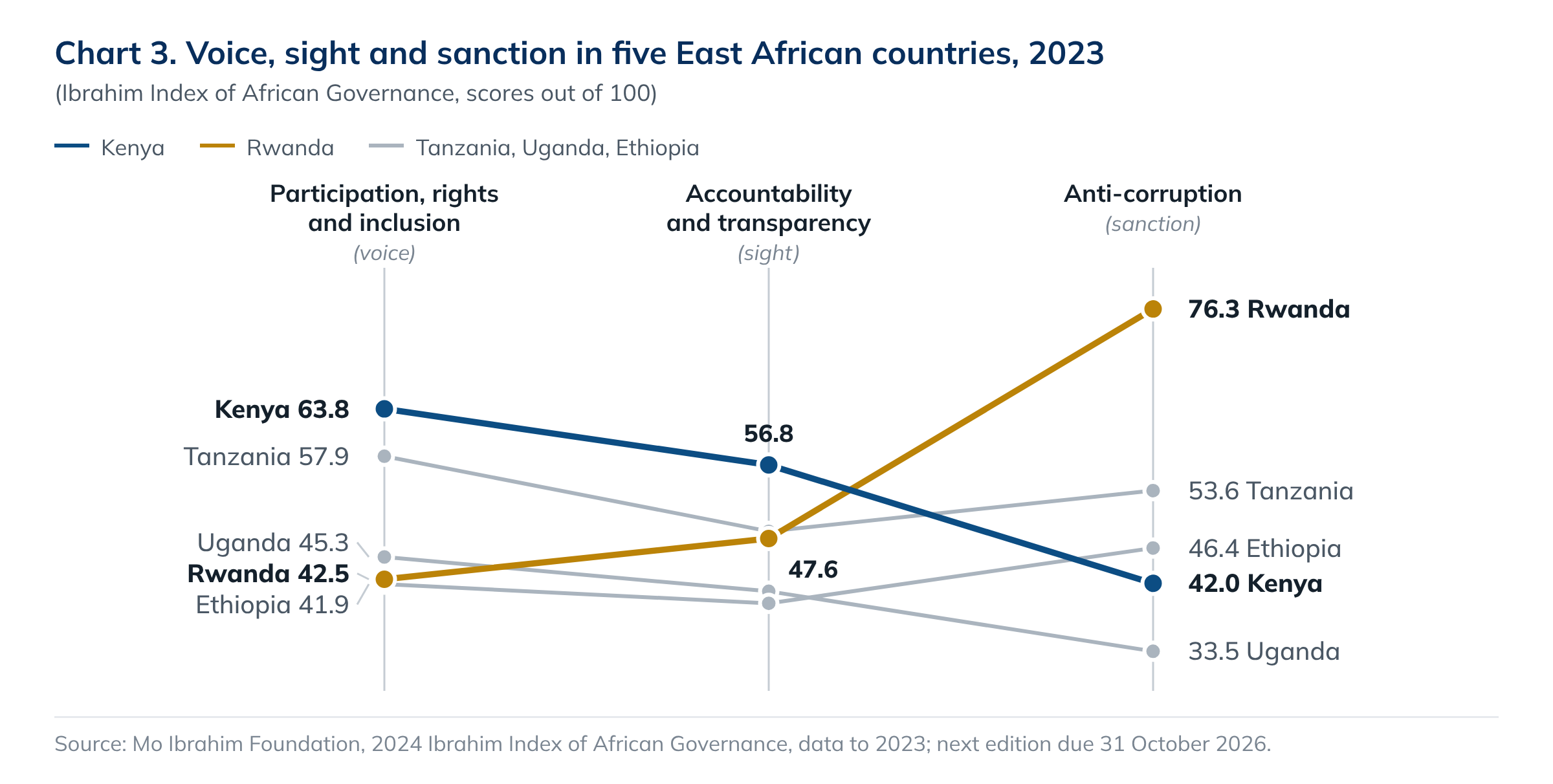
Set beside its East African peers, Kenya’s profile is unlike any of theirs (Table 2): first of the five on every measure of voice and sight, fourth on corruption. The Ibrahim Index (Chart 3) ranks Kenya 10th of 54 African countries for participation, 7th for accountability and 26th for anti-corruption; Rwanda is the mirror image, second for anti-corruption and 35th for participation. The nineteen places between Kenya’s two ranks are the gap this article is about, and field studies say why sight and voice alone do not close it: in rural Kenya, giving parents information changed nothing while giving their committees authority over a teacher reduced capture, and in Indonesia a government audit cut missing road funds where village monitoring barely moved them.13
Table 2. Five East African economies: voice, sight and consequence
| Measure | Kenya | Tanzania | Uganda | Rwanda | Ethiopia |
|---|---|---|---|---|---|
| Public participation in the budget, 0 to 100 (2025) | 44 | 13 | 28 | 26 | 7 |
| Freedom in the World, 0 to 100 (2026 edition) | 49 | 28 | 33 | 21 | 18 |
| Independent judiciary, 0 to 4 (2026 edition) | 3 | 1 | 1 | 0 | 1 |
| Budget transparency, 0 to 100 (2025) | 56 | 42 | 53 | 55 | 20 |
| Corruption Perceptions Index, 0 to 100 and world rank (2025) | 30 (130th) | 40 (84th) | 25 (148th) | 58 (41st) | 38 (96th) |
| Real GDP growth, average 2010 to 2019, percent | 5.0 | 6.3 | 5.3 | 7.1 | 9.8 |
| Real GDP growth, average 2020 to 2025, percent | 4.5 | 4.6 | 4.8 | 6.8 | 6.8 |
Sources: International Budget Partnership, Open Budget Survey 2025; Freedom House, Freedom in the World 2026; Transparency International, Corruption Perceptions Index 2025 (ranks of 182); World Bank, World Development Indicators (author’s averages). The indices rest on expert judgement and perception.
The neighbour: forty-seven places to try
Devolution gave the chain a shorter version: a county assembly sits a bus ride away, and since 2013 the 47 counties have been allocated 4.7 trillion shillings, though the centre keeps the purse tight: their share of shareable revenue, 20.7 percent in 2013/14, is about 14.4 percent in the division Parliament settled for 2026/27. Makueni, a semi-arid county of about a million people, shows what the short chain can carry: development committees that residents elect from village to ward, 526 budget forums with 40,536 participants in 2025, and the top national score for budget transparency, 89 out of 100; its Act of 2025 now requires an annual report on how far residents’ proposals were taken up. Most counties stand far from that standard: on what they publish about participation, feedback included, they averaged 23 out of 100, and they spent 25.5 percent of their outlays on development in FY2025/26 against the 36 percent budgeted, ending June 2026 with 172.5 billion shillings of pending bills, a cost carried by their suppliers, while spending 17 billion on travel. The most rigorous study of participatory budgeting in Kenya, with 9,928 respondents in four counties, found that residents tended to fall in with what the county had chosen and used the forums to ask officials about projects that had gone missing: the village meeting already works as an audit.14
Why victories leak: organised, but divided, dependent and disconnected
If victories leak, someone gains. A common answer in Kenya is that civil society is disorganised and politicians profit from the disorder; the evidence supports half of that sentence. Kenyans are not short of organisation: 46 percent of adults were active members or leaders of a voluntary association in 2016, more than in Uganda or Tanzania, and civil society organisations enjoy the trust of 58 percent of Kenyans, against 44 percent for Parliament. Politicians gain from three faults in that organisation.
The first is division: the Oxford Handbook of Kenyan Politics finds two contradictory tendencies, opposition to the state and co-optation by it, both shaped by ethnic and political lines. The second is dependence: 88 percent of the money Kenyan NGOs received came from abroad in the latest breakdown that could be sourced, which exposes the watchdog to a donor that cut its aid to Kenya by 225 million dollars in 2025 and to a government that accused 16 organisations in 2024 of using foreign money to back the protests. Kenyans are among the world’s most generous givers, but to religious bodies and to people in need, least to organised charity: Ekeh’s two publics keep separate purses.15
The third fault is disconnection, and it is the newest. The 2024 movement called itself leaderless, tribeless and partyless, and that shape protected it: there was no one to buy and, despite 82 abductions recorded by December 2024, no one whose arrest could stop it. The same shape left it without a negotiator, and the politicians reorganised faster: the Cabinet dismissed on 11 July was largely renominated by 24 July with four senior ODM figures added. The organisers’ own verdict, published in September 2026, is that the structures that kept them alive under repression made it hard to settle disagreements, raise funds or build lasting institutions.16
The thesis that disorganisation strengthens politicians therefore holds in a precise form: not a shortage of organisation but the absence of a standing link between the congregations and co-operatives, the professional civil society of lawyers and budget analysts, and the crowd. Where an organised actor held a case, the victory tended to last.
The choice: growth without voice?
Kenya’s East African peers have grown faster with less voice, and an honest account has to say so: in Table 2, Ethiopia and Rwanda outgrew Kenya in both periods, and Rwanda has cut poverty to 27.4 percent, where Kenya stands at 39.8. Three things keep that from settling the argument: Ethiopia’s expansion ran into a civil war and a default, and Tanzania’s election of October 2025 turned violent; across countries, democratisation raises income per head by about 20 percent in the long run; and the choice is no longer open: Kenyans made it in 2010, 74 percent still prefer democracy, and a constitution that spread power across 47 counties, commissions and courts cannot import another country’s teeth; it has to grow its own.17
The pen or the veto: should civil society take power?
A civil society that holds a veto will be tempted to take the pen, and the temptation is legitimate: organised citizens are a reservoir of leaders, and a constitution that vests sovereignty in the people reserves no office for parties. In Kenya the crossing has begun. The activist Boniface Mwangi seeks the nomination of the Ukweli Party, which he founded, and Senator Okiya Omtatah, perhaps the best-known face of public-interest litigation, kept suing the state after his election, leading the challenge that suspended the Finance Act of 2023, and has run a presidential exploratory committee since November 2024. Africa’s precedents show three routes to power and one alternative to it (Table 3): the ballot, which carried Zambia’s trade unions and pro-democracy groups to a landslide in 1991 and a former preacher to Malawi’s presidency in 2020; appointment, which took Kenya’s civic leaders into the government of 2003; the street, which opened transitions in Sudan in 2019 and Madagascar in 2025; and mediation from outside, for which Tunisia’s union, employers, human rights league and lawyers received the Nobel Peace Prize in 2015.18
Table 3. Civil society and power: six African precedents
| Country, years | Route | Who held power | What followed |
|---|---|---|---|
| Zambia, 1991 to 2001 | Ballot: unions and pro-democracy groups formed a party that won 125 of 150 seats | Frederick Chiluba, chairman of the trade union congress | Third term dropped in 2001 under pressure from churches, lawyers and NGOs; 46 million dollars ordered repaid by a London court, 2007 |
| Kenya, 2003 to 2005 | Appointment: civic leaders entered the new government | Ministers and officials from civil society, among them the founder of Transparency International Kenya | Watchdogs weakened; the anti-corruption official resigned in 2005; draft constitution rejected by 57% |
| Tunisia, 2013 to 2021 | Mediation: union, employers, rights league and lawyers led a national dialogue | Elected parties and presidents; the Quartet stayed outside | Nobel Peace Prize, 2015; Parliament suspended by the president, 2021 |
| Sudan, 2019 to 2021 | Street: professionals’ unions led the uprising, then shared power with the army | Abdalla Hamdok, former official of the UN Economic Commission for Africa | Removal from the US terrorism list; coup, October 2021; war since April 2023 |
| Malawi, 2020 to 2025 | Street, court and ballot: protests, an annulled election, an alliance | Lazarus Chakwera, former preacher; the coalition’s chairman as minister | Inflation above 27%; government voted out in 2025, defeat conceded |
| Madagascar, 2025 | Street: youth protests over water and power cuts | Colonel Michael Randrianirina, whose unit refused to fire | Military rule; African Union suspension; elections promised within 18 to 24 months |
Sources: Freedom House (2006, 2008); IRIN; Nobel Committee; Al Jazeera; Nyasa Times; Africanews; the other sources cited in the notes. Author’s selection and summary.
Three lessons run through these cases. The ballot can win, but it empties the watchdog’s seat: Zambia’s churches, lawyers and women’s organisations had to organise outside the government to stop the third term of a president who had come from civil society himself. Appointment weakens the watchdog from within: Freedom House found in 2006 that Kenyan civil society had weakened as its members entered government, and the board of Transparency International’s Kenyan chapter, whose founder had joined the government to fight corruption, forced out in April 2005 the director who had criticised the government’s anti-corruption record. The street can open a transition, but whoever commands force keeps the last word: Sudan’s civilian coalition shared power with an army that kept its guns, and the army took all of it back in October 2021, while Madagascar’s youth uprising of 2025 ended with a colonel sworn in as president. Malawi shows a crossing made by the rules: its coalition accepted the chairman’s resignation the day he entered politics and named an acting successor, and when the government he joined presided over inflation above 27 percent, voters, not soldiers, removed it. Tunisia shows the limit of staying outside: mediation carried a transition through 2013 and could not prevent an elected president from suspending Parliament in 2021. Where gains lasted, an organised actor had stayed outside, able to see, speak and impose an answer.
Is taking power the answer, then, and do poor results come more often from presidents formed in civil society, in business or in the public service? The research convicts no background. Leaders do shift a country’s growth path, most of all in autocracies, where their power meets the fewest constraints. Former entrepreneurs and scientists are likelier to carry out market reforms, according to a study of more than 500 leaders in 72 countries. In Russia, businessmen stand for regional office more often where the press is less free and government less transparent, and the firms of those elected to regional assemblies raised their revenue by about 60 percent over a term. In Latin America, outsider presidents, the category into which leaders from civil society usually fall, raise the risk of conflict with the legislature, attempts to dissolve it included. Each background carries its own hazard, conflict of interest for the businessman, a thin parliamentary base and little political experience for the outsider, while the public service confers no immunity: Sudan’s prime minister brought decades in international institutions and no command over the army. The equation for Kenya follows from the first finding: the president’s identity weighs most where constraints are weakest, so the surest way to improve the next president, whatever his or her background, is to finish the chain. A movement that takes office without the capacity to execute trades a veto it knows how to use for a pen it cannot yet hold.19
A civil society able to govern and one able to audit rest on the same foundations, and Kenya has most of them. Both need a bench that masters the six dimensions of execution capacity in the author’s framework (planning, budget programming, procurement, implementation, monitoring and evaluation, accountability), since no one can audit what they cannot read or govern what they cannot execute; the country’s budget analysts, auditors, public-interest lawyers, SACCO managers and elected project committees already form one. Both need members who pay and leaders who rotate, so that a departure for office leaves a successor rather than a vacancy. One rule separates them: whoever seeks office leaves the watchdog first, and the organisation endorses no one. A division of labour follows. Some of Kenya’s organised citizens will prepare to govern, with a costed programme and candidates answerable to their members; others will prepare to audit whoever wins, former activists included. Kenyans abroad can strengthen both, the first with skills and the second with money.
The horizon: 2027
The nearest horizon is the general election of 10 August 2027. Parties enter it organised, civil society scattered: the youth drive Niko Kadi made registration fashionable and 2.94 million new voters had signed up by August, but the street of 2024 mobilised without a membership list, and parties count members, agents and votes. The election is the date on which the chain will next be read in public, not the reason to mend it.20
In the election itself, civil society has a part at each stage, and Kenya’s has played every one before. Its first task is to mobilise and to inform, because the vote has been ebbing: turnout fell from 86 percent in 2013 to 78 percent in 2017 and about 65 percent in 2022, and Kenyans aged 18 to 34 made up only 39.84 percent of the 2022 register, a smaller share than in 2017: the decline Niko Kadi set out to reverse. Kenyan organisations know this work: seventy of them launched, with development partners, the National Civic Education Programme in 2000, which reached nearly a fifth of the country before the 2002 election and became the Uraia Trust in 2011, and regulations of 2017 let the commission accredit non-state voter educators. Conscientisation, in this sense, means turning the anger of the street into a choice at the ballot box: knowing what each office on the ballot controls, checking one’s registration, refusing to sell a vote that the next budget will pay for.21
Before the vote, civil society can also ask each candidate to answer in writing on the six moves set out below, publish the answers, and follow the money: 2027 should be the first general election held under the spending limits that a law of 2013 promised, which Parliament deferred in 2017 and annulled in 2021, before activists won a High Court ruling in 2022 that removed the obstacle; the commission gazetted them on 7 August 2026, with a ceiling of 6.11 billion shillings for a presidential campaign and audited expense reports from any campaign spending more than one million shillings. On polling day, it counts: in 2022 the Elections Observation Group sent 1,000 observers to a random sample of polling stations and estimated the winner’s share at 50.7 percent, within 2.1 points, against an official 50.49 percent, a check that no party could have supplied. After the vote, it can petition, as AfriCOG’s founder did in 2013, and it should expect a price: in August 2017, days after the election, the NGO regulator moved to deregister the Kenya Human Rights Commission and to shut AfriCOG, which was in court over access to the voter register. In 2027, whichever of its former members are on the ballot, civil society’s seat is the auditor’s.22
Building the builder: six moves to close the chain
None of the six moves invents an institution or borrows a model. Each finishes something Kenya has started and aims at the two links where the chain breaks, answer and act; the first three cost little and can be in place before the 2027 campaign, the last three follow the budget cycle. In the author’s 5P model of the Inclusive Spiral (People, Prosperity, Planet, Peace, Partnership), a model still under construction in L’Afrique des Idées’ research programme, Kenya’s case has a precise diagnosis: SACCOs and chamas already capture popular savings, but the execution capacity that multiplies every other coefficient breaks at the answer and the act, and a circuit whose execution fails does not close.23 Table 4 names who would carry each, what to watch, where Kenya starts and where it could stand by 2028.
Give the street a standing table. The coalitions that already exist can open a permanent table to the networks that marched in 2026, with delegates mandated and rotated by those networks and paid for by their members, which keeps the leaderless principle and adds a memory able to draft, negotiate and check that promises arrive. Dues rather than grants keep it independent, and a public log of every commitment obtained, from the insurance review promised to the drivers to the amendment on domestic violence, turns a victory in the street into an obligation that can be followed. Governed like a chama, with deliberative rather than consultative seats, peer accountability and decisions public by default, it would apply what the Spiral calls circular governance, and its delegates who stand for office would leave it first.
Answer in writing. The test of the Public Participation Bill before the Senate is a duty to publish, for each bill and budget, what was received, what was adopted and why not. Makueni’s Act of 2025 already shows the form such a duty takes; applied to each Finance Bill, it would let those who wrote to Parliament in 2026 see what their submissions changed, and give the next consultation a reason to be taken seriously.
Protect those who protest and report. Enact the draft law on assemblies before the campaign, try the protest death cases, and protect whistleblowers. The order matters: rules agreed before the campaign lower the cost of protest when it is likeliest to rise, and convictions, more than statements, persuade people that reporting is worth the risk.
Give the audit a calendar. Parliament should keep the constitution’s three months to debate each audit report and publish what became of each recommendation. The Treasury can attach each entity’s open findings to its next budget request, so that an unanswered audit costs money, and the Judiciary and the Law Society can keep a public register of court orders against the state and of their execution. A public dashboard should follow every commitment from announcement to contract to disbursement and report the share of public procurement paid to Kenyan suppliers and workers: the plan’s recirculation rate, which the Spiral uses to tell whether each round of spending comes back, and which county pending bills now erode. This is where the efficiency gain computed above is recovered.
Pay for the watchdog at home. Civil society should publish audited accounts, and SACCOs, congregations and the diaspora, which sent home 5 billion dollars in 2025, can endow community foundations that fund local scrutiny. The state’s part is to honour the tax incentives that the 2013 Act promises registered organisations; civil society’s part is to raise at home what it now raises abroad, since a watchdog paid by its members cannot be called foreign. The same circuits can finance development itself. M-Akiba, the government bond sold by mobile phone in 2017, raised 247.75 million shillings against a target of one billion, from 5,988 investors out of more than 300,000 registered; a tranche subscribed by SACCOs and chamas as groups, with the trust and the discipline of contribution they already have, is what the Spiral calls a group tranche, and it would turn that failure into a channel.
Start at the ward. Every county can do in 2027 what Makueni has written into law: publish a participation report, put an elected committee on each project and tell residents what became of their proposals. No new condition from Nairobi is needed. The Council of Governors can turn Bajeti Hub’s scores into peer review, and counties learn from each other, as Nakuru’s rise from 44 to 87 in four years shows.24
Table 4. Six moves to close the chain: baselines and proposed targets
| Move | Who carries it | What to watch | Baseline | Target, 2028 | Spiral lever |
|---|---|---|---|---|---|
| Give the street a standing table | Okoa Uchumi, Police Reforms Working Group, Bajeti Hub; the networks of 2026 | Promises of May and June 2026 kept | No standing table | Commitments logged and published each quarter | C |
| Answer in writing | Senate; clerks of Parliament and county assemblies | Participation score; share saying consultation only informs | 23/100; 58% (2025) | 50/100; under 40% | C |
| Protect those who protest and report | Parliament; prosecution service; IPOA; courts | Protest death cases tried; bribery reported | 3 of 62 in court (2026); 2.8% (2024) | 62 of 62 charged or closed with reasons; 10% | C |
| Give the audit a calendar | Public Accounts Committee; Treasury; Auditor-General | Recommendations implemented; performance audits debated | 21%; 2 of 63 | 50%; each within three months | C, ρ |
| Pay for the watchdog at home | Public benefit organisations; SACCOs; congregations; diaspora | Returns filed; NGO funding raised in Kenya | 22.4% (2022/23); 12% (2018/19) | 75%; 30% | c, C |
| Start at the ward | County governments; Council of Governors | Participation reports; development share of spending | 26 of 141 (2025); 25.5% (2025/26) | 141 of 141; 30%, the legal floor | C, o |
Sources: baselines from the sources cited in the notes; 2.8 and 12 percent are the complements of shares cited in the text (author’s calculation). Targets: author’s proposals. Spiral lever: c capture, o orientation, ρ recirculation, C execution capacity (L’Afrique des Idées, 2026).
Conclusion: the organisation Kenya has yet to build
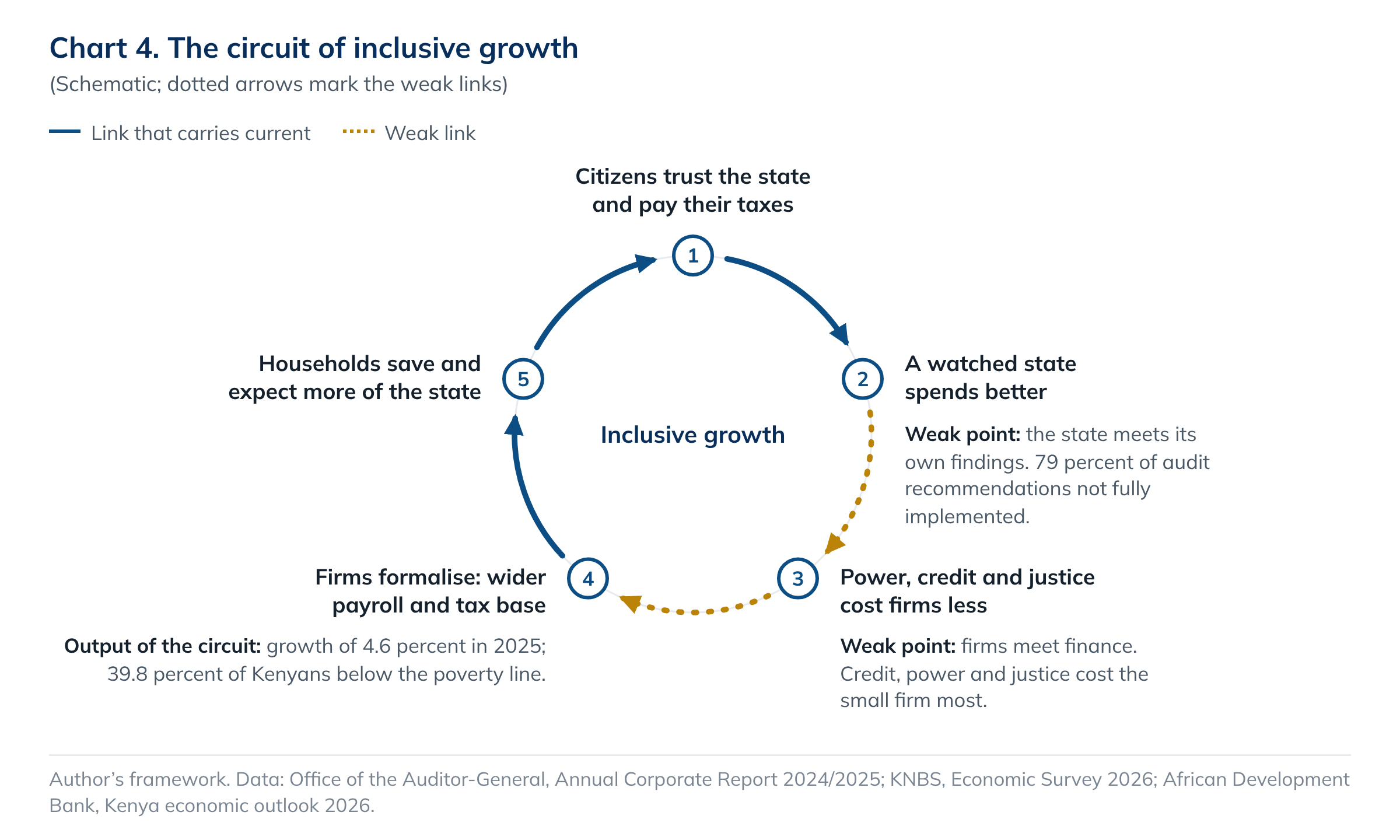
Inclusive growth runs on a circuit (Chart 4), and its current is weak at two points: where firms meet finance, and where the state meets its own findings, the point this article has followed. In the vocabulary of the Inclusive Spiral, these are the orientation coefficient and the execution capacity. The stakes are economic as much as civic: each year audit findings go unanswered, the state forgoes growth it has already paid for, and each time it legislates without answering, it spends the consent it will need for the next budget. East Africa shows two incomplete roads, Kenya’s voice without consequence and Rwanda’s consequence without voice; the constitution of 2010 commits Kenya to completing its own, with an answer owed in writing and enforced in public. The lesson travels well beyond Kenya: participation written into law becomes growth only where someone is obliged to answer.
On Parliament Road the wreaths lay on razor wire: civil society at the door of power, unwilling to go home. Wangari Maathai’s Nobel lecture asked in 2004 for something Kenya now half has: “There is also need to galvanize civil society and grassroots movements to catalyse change.”25 The movements exist; what they have yet to build is the organisation that turns a refusal into a reply, and the harambee schools, the SACCOs and the constitution of 2010 show that the builders of Kenya know how.
Notes
1. KNCHR, 29 June 2026; Interior ministry via Al Jazeera. 2025: Amnesty Kenya via Citizen Digital; KNCHR, 27 June and 11 July; IPOA. ↩
2. Afrobarometer, Round 10 for Kenya, Uganda and Tanzania; Amnesty Kenya, Kenya Freedom Index, August 2026. ↩
3. KNBS, Economic Survey 2026; African Development Bank, Kenya economic outlook, 2026; Auditor-General, summary report 2024/25, Table 20. ↩
4. SASRA via Capital FM; Afrobarometer (2024); IMF, public investment assessment, 2023; National Treasury, Budget Review and Outlook Paper 2026; IMF (2015). The calculation is the author’s: an order of magnitude, not a forecast. ↩
5. Fox (2015). ↩
6. Opalo (2021); Holmquist (1984); Barkan and Holmquist (1989); ICJ, 1997; Cottrell and Ghai (2004); IFES; Constitution of Kenya, Articles 1, 10, 35, 37, 118, 196, 201 and 258; Ekeh (1975). ↩
7. SASRA via Capital FM, assets and members; world ranking, Sacco Review; FinAccess 2024; rider SACCOs, Council of Governors, State of Devolution Address 2026; KUSCCO and NGO returns, Eastleigh Voice, February 2025 and 2024 (share: author’s calculation). ↩
8. Finance committee report, June 2024; vote, Nation; State House, 26 June 2024; Nation, 2026; KPMG, Finance Act 2026. ↩
9. Supreme Court, Ndii judgment, 2022; Adani, Citizen Digital and State of the Nation Address, 2024; partnerships law, Citizen Digital, 2026; public benefit organisations, High Court, 2016, contempt ruling of 2017 as reported by OMCT, and Legal Notice 78, 2024; Amnesty Kenya, June 2026; KNCHR, 31 October 2024. ↩
10. National Assembly, Hansard, 12 August 2026; Supreme Court, 2024; Twaweza, Brief 49, 2025. ↩
11. International Budget Partnership (2026) and its regional brief; Bajeti Hub (2026); Okoa Uchumi, People’s Audit, p. 12; Office of the Auditor-General (2025); High Court, 2022, and Okoa Mombasa. ↩
12. Office of the Auditor-General (2025); EACC, ethics survey 2024; IPOA via The Star, 22 June 2026; KBC, December 2023; Auditor-General, report 2023/24, p. 18. ↩
13. Lieberman, Posner and Tsai (2014); Duflo, Dupas and Kremer (2015); Olken (2007). ↩
14. Commission on Revenue Allocation, recommendation for 2026/27; Division of Revenue Act via Capital FM and The Star, 15 June 2026 (share: author’s calculation); Makueni, participation report 2025 and Act of 2025; Bajeti Hub (2026); Controller of Budget via Eastleigh Voice and Citizen Digital, September 2026; Touchton and Wampler (2023). ↩
15. Afrobarometer, Round 7 for Kenya, Uganda and Tanzania, and Round 10; Lugano (2020); UNDP Kenya, 2020; Center for Global Development, 2025; ICNL, Civic Freedom Monitor; Kenya Giving Report 2025. ↩
16. Ndung’u and Wanjiru (2026); KNCHR, December 2024; Citizen Digital, 24 July 2024. ↩
17. African Development Bank, notes for Rwanda and Ethiopia, 2026; PRIO (2023); Freedom House, 2026; Acemoglu, Naidu, Restrepo and Robinson (2019); Afrobarometer (2024). ↩
18. Kenya: People Daily, 26 January 2026; Business Daily, 16 July 2023; The Kenya Times, 4 October 2026; Freedom House, Countries at the Crossroads 2006; Bertelsmann Stiftung, BTI 2006, p. 3; Citizen Digital, 24 August 2022; Andreassen and Tostensen (2006). Zambia: Freedom House, 2008; IRIN, 22 February 2001; Christianity Today, May 2001; Mail & Guardian, 4 May 2007, a civil judgment; a Zambian court acquitted him of theft in 2009 (Sowetan). Tunisia: Nobel Committee, press release, 2015; The EastAfrican, 26 July 2021. Sudan: Al Jazeera, 18 December 2019; The National, 25 October 2021; Arab Center Washington DC, timeline, 2026. Malawi: The Nation, 1 April 2020; Nyasa Times, 1 April and 9 July 2020; The Star, 24 September 2025; Africanews, 24 September 2025. Madagascar: Al Jazeera, 15 and 17 October 2025. ↩
19. Jones and Olken (2005); Dreher, Lamla, Lein and Somogyi (2009); Gehlbach, Sonin and Zhuravskaya (2010); Szakonyi (2018); Carreras (2014). ↩
20. Calendar, Citizen Digital; parties, Capital FM, 12 July 2026, and Citizen Digital, 21 September 2026; Niko Kadi, The Star, 22 March 2026; registration, Eastleigh Voice, 21 August 2026. ↩
21. Turnout: Kenyans.co.ke, 9 August 2022, for 2013 and 2017; Nation Media Group, 10 August 2022, provisional figure for 2022. Register: The Star, 20 June 2022. Civic education: Uraia Trust; Elections (Voter Education) Regulations, 2017, regulation 12(3). ↩
22. Spending limits: Citizen Digital, 14 October 2021; Otele, Kanyinga and Mitullah (2026); Kenyans.co.ke, 9 August 2026; The Standard, 9 August 2026. Count: The Star, 16 August 2022. Courts and their cost: Supreme Court, judgment of 30 March 2013, Petition 4 of 2013; African Leadership Centre; FIDH and OMCT, 16 August 2017. ↩
23. Omar Ibn Abdillah, Financer le développement en Afrique, note d’analyse, L’Afrique des Idées, 2026, chapter 12: the 5P model of the Inclusive Spiral, in which execution capacity, read in six dimensions, multiplies the other coefficients; the model is presented there as under construction, its empirical validation ongoing. ↩
24. Constitution of Kenya, Article 229(8); Makueni, Act of 2025; remittances, Central Bank of Kenya via ITWeb Africa, January 2026; M-Akiba, FSD Kenya, The Story of M-Akiba, and Nairobi Securities Exchange, figures as reported by Kahawatungu; tax incentives, DLA Piper Africa; Bajeti Hub (2026). ↩
25. Wangari Maathai, Nobel Lecture, Oslo, 10 December 2004. ↩